


 Return
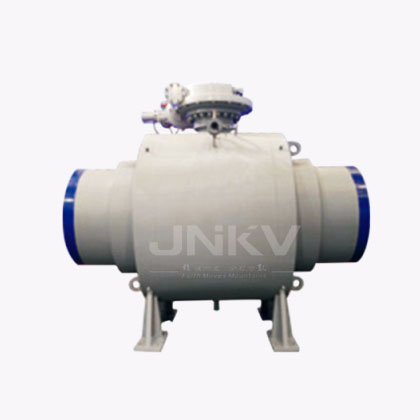

Barrel-type Fully Welded Ball Valve
Product Model: Q3/6/967F
Nominal Diameter: NPS 2"–48"
Nominal Pressure: Class 150–2500Lb
Applicable Temperature: -29°C to +200°C
Main Material: WCB, LCB, LCC, CF8, CF8M, CF3, CF3M, CN7M, CF8C, A105, LF2, F304, F316, F304L, F316L, F51
Barrel-type Fully Welded Ball Valve – Product Details
Size: Full Bore & Standard Bore DN50 (2")–DN1400 (56")
Pressure Rating: ANSI Class 150–2500, PN16–420
Working Temperature: -29°C (-20°F) to +200°C (392°F)
Applicable Media: Petroleum/gasoline, LNG/LPG, petrochemical, steel plants, heating pipelines, etc.
Operation: Lever, Gear (vertical/horizontal), Electric.Standard Features of Barrel-type Fully Welded Ball Valve
-
Solid structure with butt weld & flange ends.
-
Mirror polished stainless steel ball, fully inspected.
-
Preloaded seat spring ensures tight sealing at low temperatures and reduces valve operating torque.
-
Anti-blow-out stem according to international standards.
-
Stem dry bearing and metal with PTFE coating, self-lubricating capability, no additional lubricant required.
-
Floating or trunnion mounted ball valve.
Optional Features (Upon Request)
-
Self-relieving seat
-
Vertical installation and extended stem
-
Special ports and bores
-
Anti-static device
-
Stem emergency grease injection
-
Seat lubricant and emergency sealant equipment
-
Metal-to-metal seat sealing
-
Double block and bleed (DBB)
-
Double piston effect seat
-
Fire-safe design with graphite gasket
-
Plastic polymer for seat sealing
-
Safety valve in body cavity
-
Electroless nickel plating on ball and stem
Materials of Barrel-type Fully Welded Ball Valve
-
Body: Carbon steel ST37, A106-B, STPG 370, A105, ASTM A516-60, A216-WCB, or equivalent. Stainless steel 304 or 316 (optional).
-
Ball: Stainless steel 304 or 316 grade.
-
Seat: Metal seat with polymer sealing rings: PTFE, RTFE, Viton, Nylon, Peek, etc.
Structural Features
-
The body of the BTL fully welded ball valve is forged from high-quality materials. The ball is side-entry, and the middle flange and neck adopt fully welded connections; the fully welded structure has fewer leakage points.
-
Seat piston effect. BTL ball valves can provide 3 combinations of piston effects: ① Single piston effect seats at both upstream and downstream, i.e., DBB function; ② Double piston effect seats at both upstream and downstream, i.e., DIB-1 function; ③ Single piston effect seat upstream and double piston effect seat downstream, i.e., DIB-2 function.
-
There are two structures for the seal between the seat and the ball: one is the traditional soft seal structure, and the other is the patented BTL combination seal structure.
-
The stem is an anti-blow-out design, preventing the stem from being ejected from the body due to improper operation.
-
BTL fully welded ball valves are all equipped with fire-safe and anti-static devices.
-
Emergency sealant injection ports are designed at the seat seal and stem seal. Normal sealing does not rely on sealant. When leakage occurs due to seal surface damage, sealant can be injected for emergency repair. A grease injection valve and a built-in check valve are installed at each injection port.
-
Drain and vent ports. A drain valve is installed at the lowest position of the body for draining and venting the cavity; a vent valve is installed at the upper part of the body for online venting and cleaning of the cavity. The drain and vent valves can be isolation valves or special discharge connectors, ensuring safety, reliability, and ease of use.
-
Connection pads can be provided for various driving devices. Driving devices include levers, worm gears, electric, pneumatic, gas-hydraulic linkage, electro-hydraulic linkage, etc.
-
Convenient position adjustment. When replacing or installing the actuator online and the ball port position cannot be clearly seen, the BTL ball valve provides a special "positioning groove" to easily and accurately find the fully open and fully closed positions of the ball valve, facilitating the adjustment of the actuator's limit device.
-
For valves with welded ends, the material of the valve ends (transition section) can be adjusted according to the user's pipeline material grade to ensure material strength compatibility and weldability. For valves with pup joints at both ends, the length of the pup joints ensures that on-site welding operations do not affect the sealing materials.
-
Buried design. For buried valves, the stem is extended according to engineering requirements for above-ground operation, and the corresponding grease injection, drain, and vent devices are extended to the ground through pipes.
Design Specifications for Barrel-type Fully Welded Ball Valve
-
Design Standard: ISO 14313/API 6D, GB/T 19672, GB/T 12237
-
Face-to-Face Dimensions: ISO 14313/API 6D, ASME B16.10, GB/T 12221
-
Flange Connection Standard: ASME B16.5, ASME B16.47, GB/T 9113, JB/T 79, HG/T 20592
-
Butt Weld Connection Standard: ASME B16.25, GB/T 12234
-

